AI for Breakfast

Chris Witham • March 14, 2024

Post 58 - The use of AI in creative endeavours…


Today I've been experimenting with another AI platform, this one is called typeface.ai and it's aimed at the creative services industry, creatives and anyone else that might be interested, and people who may want to create Brand assets and advertising collateral.

Continuing the linocut chicken theme I asked it to create me an image, it created x3 options, all of which were pretty good, my favourite is below. There's alot on offer here, and I mean alot! You can set-up what they call a Brand Kit so that all your generated assets follow your branding, very clever stuff.

It will also write blog posts amongst many other things, I used my title above as a basic prompt and got a very good article back, see below, as generated, only two minor corrections!

I'm on a 30 day trial and I couldn't find any info on pricing which suggests it may be a bit more expensive than most, however if this kind of work is your everyday gig I reckon it could be worth it.

If you haven't heard of it I strongly recommend checking it out:
https://www.typeface.ai


The video on the homepage gives a great overview.


Sparking Creativity Through AI: A New Age Renaissance

Have you ever witnessed a machine creating a masterpiece? Probably not something most of us would ever think we'd ask. Yet, here we stand at the frontier of a new age. Interior design, journalism, music, and even fine arts like painting – these are just a few of the creative disciplines being revolutionised by artificial intelligence (AI). Let's delve into an inspiring and insightful exploration of how AI is not only being used in creative industries but also fostering a new wave of innovation and redefining what it means to be an artist.


The Artistic Revolution of AI

AI and art? The concept seems incongruous at first glance. After all, how can a machine, a product of cold, calculated engineering produce something as abstract and fluid as art?


In a study published by MIT, researchers introduced an AI algorithm that learns a specific style from a given dataset and generates creative works in the same manner. From recreating Rembrandt's style to producing original paintings in abstract expressionism, AI is proving to be an unexpected game-changer in the art world. AI's ability to absorb thousands of visual inputs and to create, based on these inputs, could have profound implications for the art world. It's not just about reproducing known styles—it's a whole new medium for artistic experimentation.


And it's not stopping at traditional, 2D art. Take linocut for instance: this popular printmaking technique has benefited from AI. Incorporating special algorithms and machine learning, AI can assist artists in drafting, carving, and even printing linocuts more effectively and efficiently than before.


How AI Impacts Creative Professions

AI doesn't just make waves in the realms of traditional art but is seeping into areas we would classify as "creative professions." There are AI-powered tools that can write compelling narratives and personal essays. Music making and video editing software now include AI functions to enhance the creative process. Even design tasks are benefiting from AI, enabling faster iterations and new explorations in aesthetics, ergonomics, and usage possibilities. As creative professions adapt to the new digital world, AI has not just become a useful tool but an essential component reigning in a new era of creativity in the professional realm.

Unleashing the Potential of AI in Creativity

Imagine the combination of human creativity and machine capabilities. By leveraging the power of deep learning and machine learning technologies, we can enhance our imagination and reach beyond our traditional creative limits to produce art, music, designs, and more that were once impossible. The caveat though is AI is still a tool and needs human guidance and touch. The question is no longer "is it art?" but rather "what part of the creative process did AI assist?"


It's an exciting time in the expansive world of creativity, where AI is transforming the rules of the game while making us question fundamental concepts like, what makes an artist, or what qualifies as art?

Wrapping Up

Art and creativity are synonymous with human emotion, intuition, and insightfulness – the very elements that define our humanity. But does the introduction of AI into our creative world spell doom for traditional artistry, or does it offer new possibilities for the artist, the artwork, and the audience?


The elegance of this new age renaissance is that it's not about AI replacing human creativity but enriching it. AI is not eating the arts, it is transcending them, offering a ticket to creative and technological horizons we've just begun to explore.


So, whether you are an artist, a designer, a creator, or just an art enthusiast, the rise of AI in creativity presents an opportunity to redefine the limits of what is possible and to reimagine how we perceive, produce, and interact with art. Is this the budding genesis of AI-art collaboration?


Only time and technology will tell.
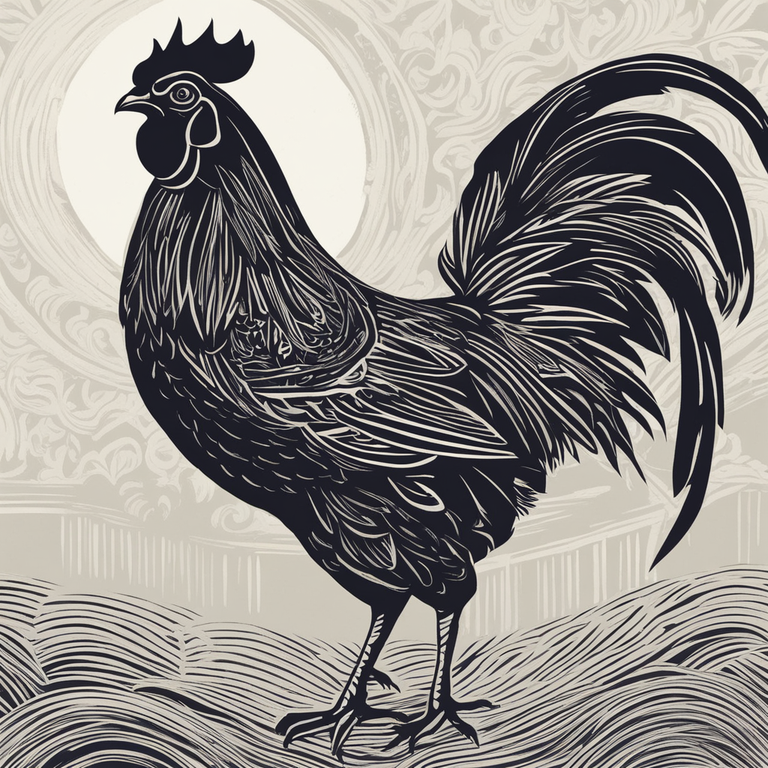
a black and white drawing of a rooster standing in a field
Lines of colorful computer code on a dark background.
By Chris Witham December 11, 2025
Where AI really helps your Business If you spend any time on LinkedIn or X, you’ll have seen bold claims about how AI can help you build software in a matter of days. There’s a lot of excitement, a lot of big promises, and a fair bit of confusion for business owners trying to work out what’s real. A new term doing the rounds is “Vibe Coding” —the idea of describing what you want to an AI assistant and having it generate the code for you. It’s becoming popular because it can move things forward quickly and help people explore ideas they wouldn’t have been able to create alone. And the truth is, it does have its place. The challenge isn’t the technique. It’s the expectation that AI will automatically deliver finished, reliable, production-ready tools without any real design or thinking behind them. AI accelerates the work you already do well Used properly, AI can: • Remove huge amounts of repetitive work • Speed up drafting and iteration • Generate working prototypes in hours • Help non-technical people explore ideas • Improve documentation, planning and communication This is where it shines. But it still needs clarity, structure, and well-designed processes around it. It’s like having a very fast assistant rather than a fully formed development team. Why many AI projects don’t deliver what people expect Independent research this year showed a clear pattern: • Many early AI initiatives failed to produce measurable business value • Companies abandoned AI ideas because they couldn’t scale or integrate them • The gap between an impressive demo and a reliable tool is larger than people thought This doesn’t mean AI is overhyped. It means teams jumped straight to execution without the groundwork. The technology isn’t the issue. It’s the approach. Small businesses don’t need Enterprise Platforms Most UK small businesses don’t need to build a full software product. What they actually need is: • Better workflows • Faster content generation • Clearer communication • Improved customer support • Tools that reflect the way they work • Consistency and repeatability AI is perfect for this. A custom GPT trained on your tone, your documents and your processes can become: • A writing assistant • A customer support helper • A knowledge base navigator • An internal guide for staff • A quality-control layer • A process automator No engineering team needed. No complex infrastructure. No stress. Where AI builds real value right now AI works best when it’s part of a thoughtful, guided approach: • Define the outcome you want • Build a lightweight prototype (AI helps here) • Add structure, rules and guardrails • Connect it to your real workflow • Test it with real users or staff • Iterate until it feels natural You can still move fast. You just avoid building something brittle that breaks the moment it’s needed. The key insight: AI doesn’t replace expertise, it amplifies it AI is at its strongest when someone knowledgeable decides: • What it should do • What it shouldn’t do • How it should behave • What tone it should use • How it fits into the business • What checks and constraints matter That’s where tools like custom GPTs genuinely shine. They’re not software products in the traditional sense. They’re flexible assistants shaped around your business. With the right design, they can save huge amounts of time and deliver consistent, practical value without any of the complexity of building a full system. A more useful way to think about AI in 2026 Instead of “AI will build everything for you”, a healthier mindset is: AI speeds up the work, but you set the direction. For small businesses, that’s more than enough to make a real difference.
By Chris Witham August 21, 2025
Website Planet Interview
January 16, 2025
THOUGHT OF THE DAY: 'An investment in knowledge pays the best interest.' - Benjamin Franklin EXPLANATION: This quote reminds us of the enduring value of learning and education as a pathway to success.
January 15, 2025
WORD: Egregious DEFINITION: Outstandingly bad or shocking. USAGE: 'The error in the report was so egregious it couldn’t be ignored.' ORIGIN: From the Latin 'egregius,' originally meaning 'distinguished' or 'remarkable,' later used ironically to highlight glaring faults.
January 14, 2025
TRADE FOCUS: Chef AI APPLICATIONS: - MENU DESIGN: AI creates innovative recipes based on available ingredients. - SUPPLY MANAGEMENT: AI predicts ingredient needs to minimise waste. - CUSTOMER INSIGHTS: AI analyses feedback to improve dish offerings. - SKILL TRAINING: AI provides virtual cooking lessons and techniques.
January 13, 2025
On 13th January 1898, Émile Zola published 'J'accuse,' an open letter defending Alfred Dreyfus, which became a pivotal moment in the Dreyfus Affair.
January 12, 2025
IDIOM OF THE DAY: Bite off more than you can chew FIGURATIVE MEANING: To take on a task that is too difficult to manage. TYPICAL USAGE: 'She bit off more than she could chew by agreeing to organise the entire event.' ORIGIN: Likely from the literal difficulty of chewing an overly large piece of food.
January 11, 2025
IDIOM OF THE DAY: Throw in the towel FIGURATIVE MEANING: To give up or admit defeat. TYPICAL USAGE: 'After hours of trying, he threw in the towel and called for help.' ORIGIN: From boxing, where a towel is thrown into the ring to signal surrender.
January 10, 2025
AI GENERATED HUMOUR: Why did the AI bring a notepad to the beach? To take down sandy data! This joke connects AI’s data-driven nature to a playful seaside scenario.
January 9, 2025
THOUGHT OF THE DAY: 'The only way to do great work is to love what you do.' - Steve Jobs EXPLANATION: This quote highlights the importance of passion in achieving excellence in one’s work.
January 8, 2025
WORD: Ineffable DEFINITION: Too great or extreme to be expressed in words. USAGE: 'The beauty of the sunrise was ineffable, leaving everyone speechless.' ORIGIN: From the Latin 'ineffabilis,' meaning 'unutterable,' often used to describe profound experiences.
January 7, 2025
TRADE FOCUS: Jeweller AI APPLICATIONS: - DESIGN CREATION: AI generates intricate jewellery designs based on current trends. - GEMSTONE ANALYSIS: AI evaluates the quality and authenticity of gemstones. - CUSTOM ORDERS: AI creates virtual previews for bespoke pieces. - INVENTORY MANAGEMENT: AI optimises stock levels and demand forecasting.
January 6, 2025
On 6th January 1838, Samuel Morse successfully demonstrated the first public telegraph message, marking a revolution in communication.
January 5, 2025
IDIOM OF THE DAY: Put all your eggs in one basket FIGURATIVE MEANING: To risk everything on a single venture. TYPICAL USAGE: 'Investing all your money in one stock is like putting all your eggs in one basket.' ORIGIN: Likely from the precariousness of carrying all eggs in one basket, risking breaking them all if dropped.
January 4, 2025
IDIOM OF THE DAY: Spill the beans FIGURATIVE MEANING: To reveal a secret. TYPICAL USAGE: 'She spilled the beans about the surprise party.' ORIGIN: Likely derived from voting practices in ancient Greece where beans were used, and spilling them prematurely could reveal results.
January 3, 2025
AI GENERATED HUMOUR: Why did the AI start a podcast? It wanted to amplify its voice! This playful joke ties AI’s communication abilities to the world of podcasting.
More Posts